Inside the Alpaca Show Ring
What the ribbons, banners, and judging really mean.

Kinleigh showing for the first time in front of Judge, Laurel Shouvlin.

Illini's Work of Art shown by Sierra.

Stillmeadow Farm Candy's Scandal receives a Judge's Choice at Heart of VA.

Stillmeadow Farm Levi Defiance shown by Mackensi.

Elderwood's Crossbones by Blackbeard shown by Brady.
Inside the Alpaca Show Ring
If you’ve ever seen a photo of an alpaca surrounded by ribbons and banners and wondered what any of it actually means, you’re not alone. The alpaca show world has its own language.
Blue ribbons. Color Championships. Reserve Championships. Judge’s Choice. Bred & Owned. Walking Fleece. Supreme Champion.
To someone outside the industry, it can all start to look like different versions of the same award, but that isn't the case. Each represents something different about the alpaca, the competition, or the breeding program behind it.
For us, showing has never been simply about collecting banners. The show ring is one of the tools we use to evaluate whether the breeding decisions we’re making are moving us in the right direction. It provides something difficult to recreate at home: an experienced, independent set of eyes evaluating our alpacas alongside animals produced by other breeders.
What Is an Alpaca Show?
Most of the shows Elderwood attends are certified through the Alpaca Owners Association (AOA) Show System.
AOA-certified competitions operate under a national set of rules and use certified judges. Depending on the event, competitions may include halter, walking fleece, shorn fleece, performance, production classes, fiber arts, and other divisions.
For breeding animals, you’ll most commonly hear us talking about three:
- Halter - the live alpaca is evaluated for both conformation and fleece.
- Walking Fleece - the fleece is evaluated while still growing on the alpaca.
- Fleece Show - the fleece is shorn and submitted separately for anonymous evaluation.
Each tells us something different.
Halter: Evaluating the Whole Alpaca
Halter is probably what most people picture when they think of an alpaca show.
An alpaca and handler enter the ring with the other animals in their class. The judge evaluates the alpacas individually, then compares them against one another.
In current AOA full-fleece halter competition, fleece and conformation receive equal emphasis — 50% each. That distinction is important. An alpaca doesn’t win halter solely because it has beautiful fleece. And it doesn’t win solely because it is structurally impressive. The judge is evaluating how well the pieces come together.
Conformation
The judge may evaluate characteristics such as:
- Overall balance and proportion
- Structural soundness
- Movement
- Front and rear leg alignment
- Body capacity
- Head and breed type
- Bite
- Reproductive soundness where applicable
The goal is a physically sound alpaca whose structure supports a long, productive life.
Fleece
The judge also gets hands-on with the fleece.
For a Huacaya, that can include characteristics such as:
- Fineness
- Uniformity
- Density
- Staple length
- Brightness
- Character and staple organization
- Absence of undesirable coarse fiber
- Overall fleece quality and coverage
Suri fleece is evaluated using characteristics appropriate to Suri, including luster and lock structure.
That’s why you’ll see judges opening the fleece at several places across an alpaca’s body instead of looking at one impressive spot on its side. A breeding animal needs more than one good square inch of fleece.
Who Competes Against Whom?
Alpacas don’t simply walk into one enormous ring and compete against every alpaca at the show. Classes are organized so animals are compared with reasonably similar competitors.
Depending on entries and the competition, classes can be divided by:
- Breed: Huacaya or Suri
- Gender: Male or female
- Age: Juvenile, yearling, two-year-old, mature, etc.
- Color or color group
AOA rules then determine when colors can remain separate and when classes or championship groups must be combined based on entry numbers. That matters when interpreting a result. A blue ribbon means an alpaca won its class. It doesn’t necessarily mean it defeated every alpaca of that color at the show. That’s where championships come in.
From Blue Ribbon to Banner
This is where show terminology becomes much easier once you see the progression.
First Place
A blue ribbon means the alpaca placed first in its individual class. AOA-certified halter shows may place through sixth when sufficient entries are present. A first place can be an excellent accomplishment, particularly in a large or competitive class. But it is the beginning of the championship process - not the end.
Color Champion
If the required number of alpacas is present for a championship, qualifying first- and second-place animals advance. The first-place animals initially form the championship lineup. The judge selects a Color Champion from those class winners. That alpaca has therefore done more than win its age class. It has been selected over the other qualifying class winners within that championship group.
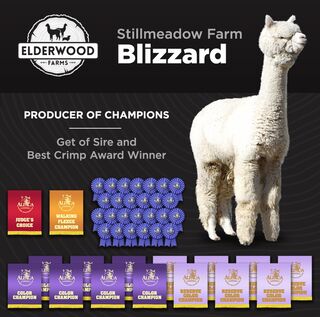
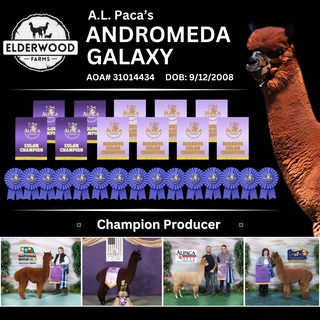
That’s the banner you commonly see labeled: Color Champion or Champion
Reserve Color Champion
Once the Champion is selected, the second-place alpaca from the Champion’s original class moves forward into the championship lineup. The judge then selects the Reserve Color Champion from the remaining eligible animals. That detail surprises a lot of people. An alpaca does not necessarily have to win its original class to eventually become Reserve Champion. If it placed second behind the animal ultimately selected Champion, it gets another opportunity because logically it could still be the second-best animal in the entire championship.
What Is a Judge’s Choice?
This is a much broader award. Once enough championship divisions have been completed, qualifying Color Champions can return to the ring for Judge’s Choice. Best Bred & Owned winners may also be eligible under current AOA rules.
Now the judge may be comparing alpacas of very different colors. White against black. Fawn against grey. Multicolor against brown.
The question is no longer: Which is the best alpaca in this color group?
It becomes: Which alpaca best represents excellence across the judging criteria?
AOA describes Judge’s Choice as recognizing the animal representing the strongest summation of positive characteristics across the judging criteria. That’s why we place particular value on a Judge’s Choice. The animal has moved beyond its individual class and color competition and is being evaluated against champions from across the show.
Bred & Owned: A Different Kind of Achievement
This is one of our favorite parts of the show system.
Bred & Owned competition was designed to recognize production from an ongoing breeding program rather than an alpaca purchased after someone else made the breeding decision.
Under current AOA rules, the exhibitor must own the alpaca and must have owned its dam when that breeding was made.
In other words:
- You selected the pairing.
- You produced the alpaca.
- You raised it.
- And now you’re presenting the result.
That’s very different from purchasing an already successful show animal. There is absolutely nothing wrong with purchasing quality animals - every breeding program builds from genetics developed by others.
But Bred & Owned gives us feedback on the decisions we made ourselves. Winners can ultimately compete for Best Bred & Owned, and those winners may also qualify for Judge’s Choice when the show’s requirements are met. For a breeding program, that makes the award particularly meaningful.
Production Classes: Can They Reproduce It?
Individual wins tell us about one alpaca. Production classes begin asking a different question: Can those qualities be reproduced?
AOA offers several group production classes.
- Get of Sire - Three offspring from the same sire are evaluated together. The judge is looking for evidence that the sire is consistently transmitting positive fleece, conformational, type, and style characteristics to his offspring.
- Produce of Dam - Two offspring from the same dam are evaluated together. Again, the emphasis is on the parent’s ability to consistently pass desirable traits into the next generation.
- Breeder’s Best Three - A breeder presents three animals representing the quality of its own breeding program. This begins evaluating something larger than one sire, dam, or show animal. It begins evaluating the program. That is important to us because an alpaca can have a remarkable individual show career and still fail to reproduce those qualities consistently.
Ultimately, breeding programs have to produce generations, not just winners.
What Is Walking Fleece?
Walking Fleece gives us a completely different look at an alpaca.
The animal is brought into the judging area, but unlike halter, the competition is focused on the fleece growing on the animal. Each alpaca is evaluated individually and receives a scorecard.
For Huacayas, the current AOA scorecard considers characteristics including fineness, handle, several measures of uniformity, character, density, brightness, color consistency, fleece condition, and length uniformity. Suri scoring emphasizes corresponding Suri characteristics, including luster and lock structure.
Conformation isn’t what Walking Fleece is testing. That makes it useful.
An alpaca might therefore have: a halter result telling us how the whole animal compared and a Walking Fleece result giving us much more concentrated feedback about the fleece itself.
We like having both.
And a Shorn Fleece Show?
A traditional fleece show goes one step further. The alpaca doesn’t attend at all. Its shorn fleece does.
Fleeces are entered anonymously and evaluated using an AOA scorecard against an ideal fleece. Judges assign points across individual characteristics, and the scores determine class placements.
There are advantages to this format. A judge can spend considerably more time examining the fleece than would ever be practical while an alpaca is standing in a halter ring. The fleece can be opened completely, measured, handled, and because entries are identified to the judge by entry number rather than owner or farm, the evaluation is blind.
Halter, Walking Fleece, and shorn fleece competitions therefore aren’t redundant. They’re different views of the same animal.
What About the AOA National Show?
The AOA National Alpaca Show brings another level of competition. One feature is the Invited Champion pathway.
Under current rules, an alpaca that earned a qualifying championship or Best Bred & Owned award at an AOA Certified Show during the preceding calendar year may enter Nationals as an Invited Champion. Those animals advance directly to the National Color Championship rather than competing through another preliminary class.
The National Show also culminates in the National Supreme Championship. National Color Champions and qualifying Best Bred & Owned winners advance into Supreme competition, where the National halter judges collectively select Supreme Champions across breed, gender, and light/dark groups. It’s one of the highest recognitions available within the AOA Show System.
Does Winning Prove an Alpaca Is Great?
Not by itself. And we think this is important to say. A show result is one evaluation on one day.
Judges are highly trained, but alpaca judging still involves comparison and professional judgment. Different judges may prioritize characteristics somewhat differently within the same established standard.
Competition also changes. A first place in a class of two isn’t exactly the same competitive experience as winning a class of eleven. An alpaca may mature. Fleece changes with age. Condition changes. And an alpaca that never became a major show winner can sometimes become an exceptional producer. The opposite can happen too. That’s why we don’t believe a banner should make every breeding decision for us.
What the Show Ring Does Give Us
What showing provides is feedback. If one judge identifies a weakness, we listen. If several judges independently identify the same weakness, we pay closer attention. If an animal succeeds across different shows, regions, judging panels, competition types, and stages of maturity, that becomes more meaningful.
And when its offspring begin doing the same? Now we’re learning something about the breeding program. That’s the value we see in the show ring. Not validation for validation’s sake.
Winning Is Fun. Learning Matters More.
We won’t pretend we don’t enjoy the banners - of course we do! There is something pretty special about hearing an animal you bred called forward for a championship and seeing the results of your breeding progam. But some of our most important moments in the show ring haven’t involved winning at all.
Sometimes it has been a judge explaining exactly why another alpaca stood ahead of ours. Sometimes it’s recognizing a weakness we hadn’t fully appreciated. Sometimes it’s discovering that a trait we were working toward really is improving. And sometimes it’s standing sixth in a class of eleven and being thrilled simply because we finally belonged in the lineup.
Showing gives breeders the opportunity to put their work in front of someone else and ask: What are you seeing?
Then we get to decide what we’re going to do with the answer.
For Elderwood, that’s ultimately what the alpaca show ring is about.
Evaluate. Learn. Breed forward.
Show rules and class requirements can change. For current competition rules, visit the AOA Show System Handbook.
Monday, September 7, 2026
Featured Items